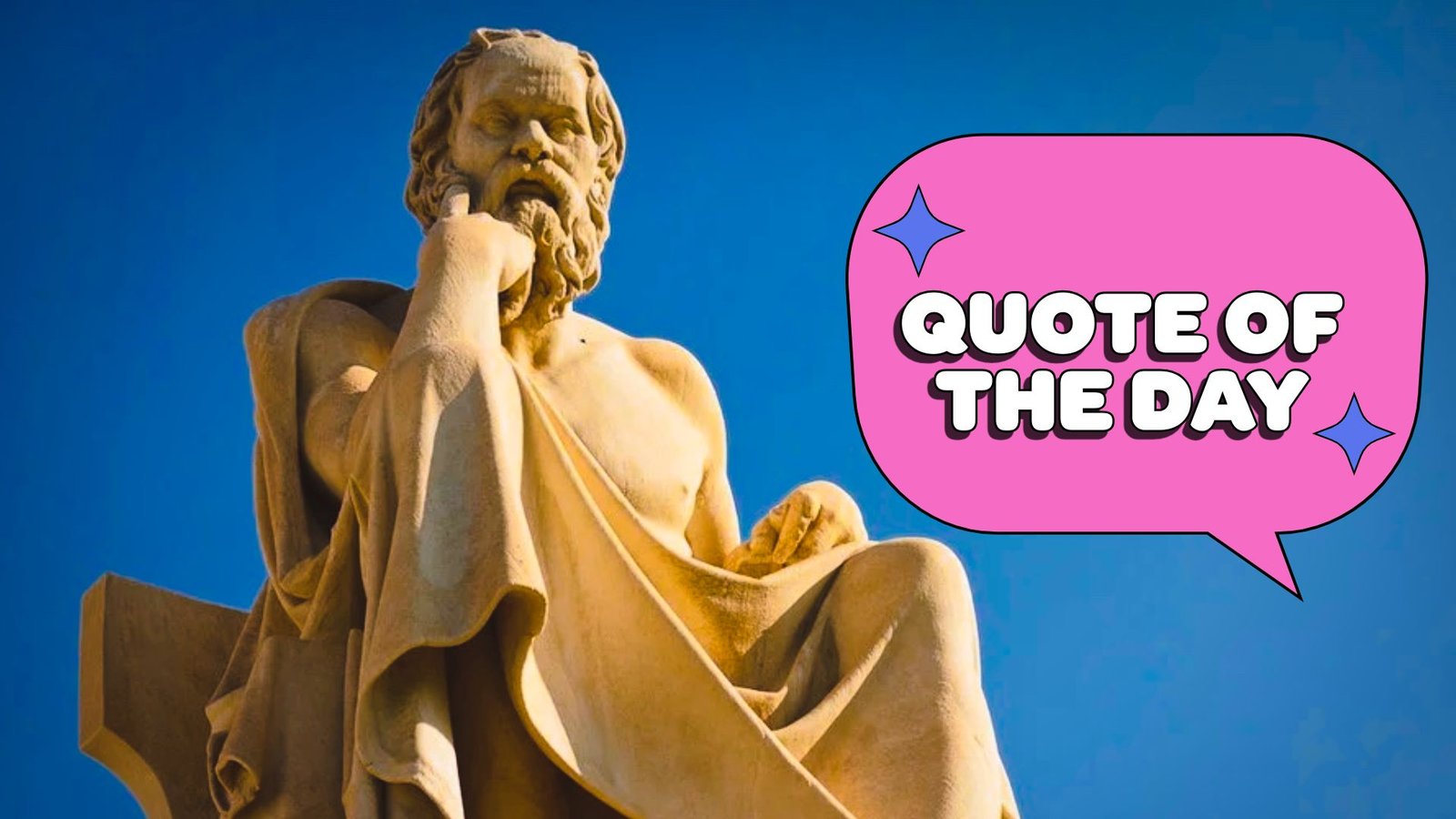
Socrates, a Greek philosopher, is credited with the concept of wisdom beginning with the acknowledgment of ignorance. This notion can be summed up by our quote of the day by Socrates:The only wisdom is to know you know nothing. It forms a basis of western logic and scientific method.
The only true wisdom is to know nothing is a quote by the Greek philosopher Socrates. It is based on the Apology by Plato, which narrates the trial of Socrates in 399 BCE. The quote is a sign of intellectual humility. It implies that one can only be wise when he or she acknowledges his/her own ignorance.
Quote of the Day by Socrates
“The only true wisdom is in knowing you know nothing.”
The precise text also differs among the English translations of the ancient Greek works. The most popular form applied in general knowledge application is: The only true wisdom is in knowing you know nothing.
In the Apology by Plato, this sentiment is expressed in a broad way. Socrates clarifies that he does not believe that he knows what he does not know. He concludes that he is probably smarter than the rest of the people since he does not profess to know what he does not know. It is this realization that is the foundation of what is known by historians as Socratic irony.
Who was Socrates?
Socrates was a renowned Athenian philosopher of the 5th century B.C. He has been termed as the father of western philosophy. Socrates did not write any paper or books as most scholars did. His concepts lived on by the works of his pupils, mainly Plato and Xenophon.
He used to spend his days in the marketplace of Athens, called the Agora. He never lectured his students. Rather, he posed hard questions to them to reveal inconsistencies in their reasoning. This method is presently referred to as the Socratic Method. It is still a common instructional aid in law schools and universities.
Context of the Quote
The context of this quote is based on the legend of Pythia, an Oracle of Delphi. A man named Chaerephon, posed a question to the Oracle (Pythia) that whether anyone was wiser than Socrates. The Oracle responded that there was no one who was wiser.
This answer perplexed Socrates. He thought that he had no special knowledge or skills. In order to verify the assertion of the Oracle, he questioned the most renowned men of Athens. He addressed politicians, poets and talented artisans.
He found that these professionals thought that they knew a lot. But upon questioning them, Socrates found out that they were shallow or lying in their knowledge. Socrates came to the conclusion that the Oracle was right. He was the most wise in that he was the only one who knew how ignorant he was. Other men were ignorant, but they thought they were wise.
Meaning of the Quote
The quote, when taken literally, is a statement concerning honesty. It implies that by saying that one knows it all, he/she cannot learn anything new. When you think you know all the things, then you cease to ask questions.
The meaning of interpretation is concerning the worth of intellectual humility. It differentiates two kinds of individuals:
1. The ignorant, who are supposed to be wise.
2. Wise ones, because they know the confines of their mind.
Socrates could pursue truth without prejudice by acknowledging that he did not know anything. There was no definite ego to protect. This attitude enabled him to scrutinize all ideas in a completely objective manner. This is the key to the contemporary scientific research and critical thinking.
What Makes This Quote Relevant?
This quote is still applicable since it cautions against the perils of overconfidence. Nowadays, individuals tend to experience a filter bubble in which they are presented with only information that supports their already held beliefs. Socrates urges the contrary. He dares individuals to confess when they are wrong or uniformed.
The Socratic Method was a result of his philosophy. This technique involves collaborative discussion to evoke critical thinking. It is applied in law, psychology and medicine to get deeper truths. The quote is also a reminder that the more we know the more we know that we still have much to learn.
ALSO READ: Quote of the Day: Winston Churchill on Vengeance
More quotes by Socrates
1. “An unexamined life is not worth living.” This means you should think about why you do the things you do.
2. “Be kind, for everyone you meet is fighting a hard battle.” You should treat others with care because you do not know their struggles.
3. “To find yourself, think for yourself.” It is important to form your own opinions rather than just following the crowd.
4. “Strong minds discuss ideas, average minds discuss events, weak minds discuss people.” Focus your talk on big thoughts instead of gossip to grow your brain.
Socrates transformed philosophy through his interest in the human mind as opposed to the physical world. His argument that wisdom commences with the acknowledgment of ignorance was a radical one to the so called experts of the time. This 2,400 years old wisdom, is the basis of logic and fair discussion. The most important weapon of personal and intellectual development is to know what you do not know.